
Recently, the research team led by Professor Qin Wang from the School of Communications and Information Engineering at Nanjing University of Posts and Telecommunications (NUPT) has made a series of important research advances in practical quantum key distribution (QKD) networks and published two key academic papers in internationally renowned journals.
The paper “A Directly Modulated Laser Platform for High-Dimensional Quantum Key Distribution” was published in Photonics Research, a well-known international journal in optics (DOI: 10.1364/PRJ.588031). Yang Zhou, a PhD candidate, and Associate Professor Xingyu Zhou from the Institute of Quantum Information Technology, School of Communications and Information Engineering, NUPT, serve as co-first authors. Professor Qin Wang is the corresponding author. The research team led by Researcher Zhiliang Yuan from the Beijing Academy of Quantum Information Sciences made important contributions to this work. The paper “Reference-frame-independent quantum key distribution network with directly-modulated sources” was published in Physical Review A, a prestigious journal in physics (DOI: 10.1103/szbp-b3ny). Associate Professor Xingyu Zhou and Shufan Wu, a master’s student from the Institute of Quantum Information Technology, School of Communications and Information Engineering, NUPT, are co-first authors. Professor Qin Wang acts as the corresponding author. The group of Pavel Victorovich Morozov from Moscow State Pedagogical University, Russia, provided important support for this study. The field experiments received strong support from the University Information Construction and Management Office regarding the access and operation guarantee of inter-campus optical fiber links.
Quantum key distribution (QKD) is built on the fundamental principles of quantum mechanics and can in principle provide information-theoretic security for communications. For long-distance and large-capacity quantum network applications, existing QKD systems still face multiple challenges including transmission rate, noise tolerance, system complexity and long-term stability. High-dimensional QKD can break the inherent limitations of conventional two-dimensional protocols in information capacity, noise tolerance and security thresholds. It can achieve higher key rates under the same detection rate or channel bandwidth, making it one of the key research directions in quantum communication. Nevertheless, existing high-dimensional QKD systems usually rely on complex quantum state preparation and measurement architectures, which restrict their further practical deployment and integration.
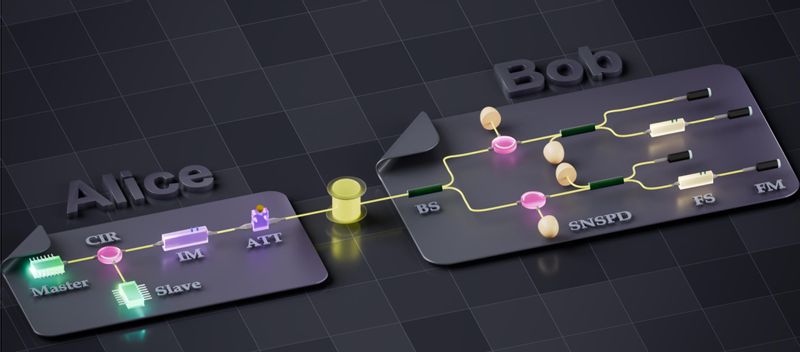
Figure 1 Schematic Diagram of High‑Dimensional QKD Experimental System
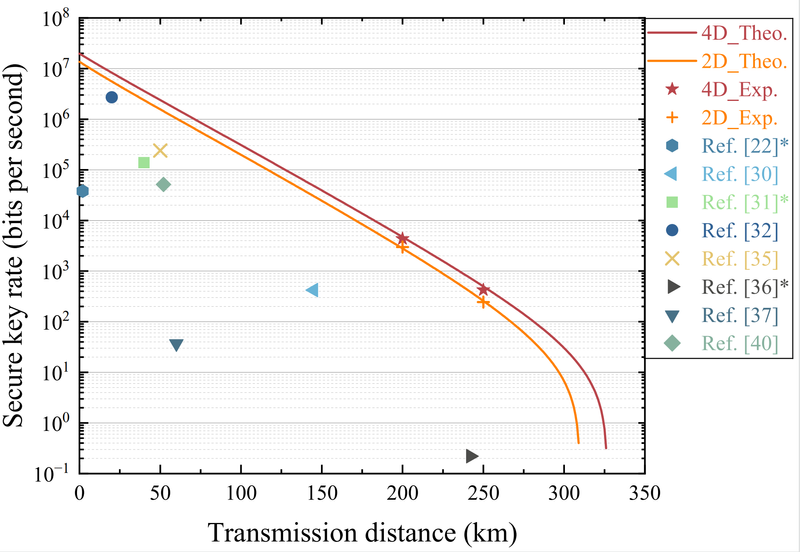
Figure 2 Comparison of Key Rates Between This Work and Reported High‑Dimensional QKD Experiments
To tackle the above challenges, the team designed a high-dimensional encoding and decoding platform based on directly modulated light sources and constructed a high-dimensional QKD system with a repetition rate of 312.5 MHz. Experimental verification was carried out over indoor optical fibers with transmission distances of 200 km and 250 km respectively. Experimental results demonstrate that the proposed high-dimensional QKD system exhibits significantly better performance than conventional two-dimensional schemes under identical hardware conditions. This work lays a foundation for the future construction of low-complexity, high-performance and integrable long-distance high-dimensional QKD systems.
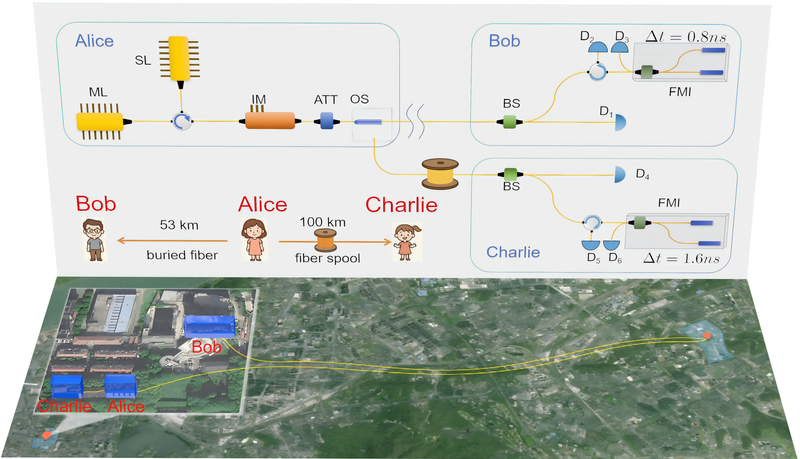
Figure 3 Schematic Diagram of Field Reference‑Frame‑Independent QKD Network
For multi-user quantum network field applications, continuous environmental variations lead to persistent reference frame drifts between different QKD network nodes. Traditional QKD systems require frequent reference frame calibration among nodes, raising the complexity and cost of network operation and maintenance. The reference-frame-independent QKD protocol reduces reliance on real-time alignment and offers a vital solution for building low-maintenance, scalable quantum secure networks.
In the research on reference-frame-independent QKD networks, the team proposed and constructed a three-node QKD network architecture adopting directly modulated light sources. The system achieved continuous 24-hour operation without reference frame calibration over a 53 km deployed metropolitan optical fiber link between the Sanpailou and Xianlin campuses of Nanjing University of Posts and Telecommunications, with a maximum secure key rate of 27 kbps. When connected to a 100 km laboratory fiber link, the system enables on-demand user switching for communication, and reference frame recalibration is unnecessary during link reconfiguration. This work reveals the great application potential of directly modulated laser platforms and reference-frame-independent QKD protocols in low-maintenance, reconfigurable quantum networks.
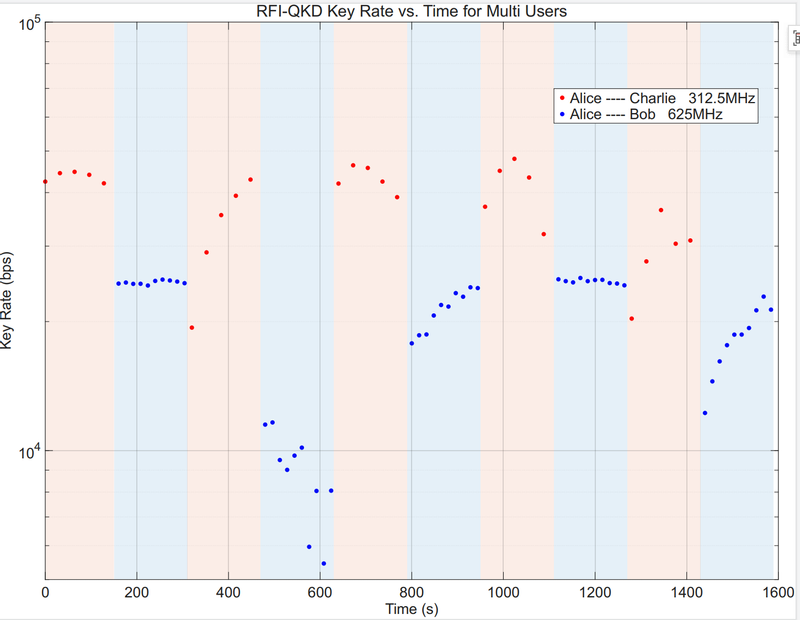
Figure 4 Key Rate Variations of Heterogeneous QKD Network Under Dynamic Multi‑User Link Switching Without Reference Frame Calibration
This research was supported by the National Natural Science Foundation of China, the Natural Science Foundation of Jiangsu Province and the Key Research and Development Program of Jiangsu Province. NUPT is the primary completion unit and corresponding author institution for both research outcomes.
(Author: Qin Wang Preliminary Review: Lei Xu, Xiubin Dai Editor: Cunhong Wang Final Review: Feng Zhang)