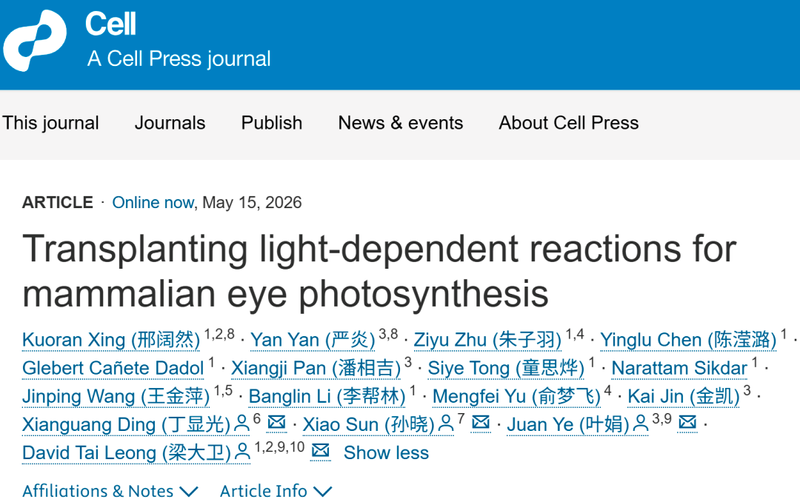
Recently, Professor Ding Xianguang from the State Key Laboratory of Flexible Electronics and the School of Chemistry and Life Sciences, in collaboration with Professor Sun Xiao from Shandong First Medical University, Professor Ye Juan from the Eye Center of the Second Affiliated Hospital of Zhejiang University, and Professor Liang Dawei from the National University of Singapore, co-authored a research paper online in the top international academic journal Cell as co-corresponding author, titled Transplanting light-dependent reactions for mammalian eye photosynthesis. This marks the first time NJUPT has published a scientific achievement in Cell, representing a major breakthrough with international visibility in related frontier fields and a historic leap in the university's output of high-level research achievements in this discipline.
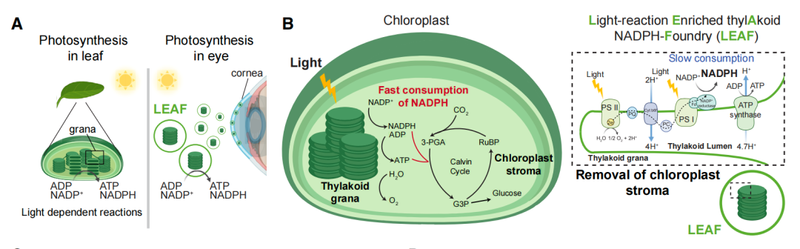
For a long time, medical applications of light have largely focused on laser surgery, photodynamic therapy, photothermal therapy, and imaging diagnostics. These techniques typically rely on external devices and use light as a stimulus or detection signal. This study proposes an alternative approach: instead of merely illuminating tissues with light, the team introduced a light-energy conversion system into cells, enabling them to obtain additional energy support from ambient light. In other words, the team sought to upgrade light from an external therapeutic tool to an energy input for cellular repair processes. To achieve this goal, the team extracted the core structure of plant photosynthesis—thylakoid grana—from spinach, preserving the light reaction system responsible for capturing light energy and electron transfer. The researchers nano-encapsulated this system using biocompatible materials to construct a nanophotosynthetic system named LEAF. Unlike conventional nano-delivery materials, LEAF does not merely transport drugs or molecules; it retains a functional photoelectron transport chain capable of continuously converting light energy into biochemical energy within cells. From an interdisciplinary perspective of medicine and engineering, LEAF functions more like a miniature bio-photoelectronic system. It possesses nanoscale dimensions, cellular uptake capability, biostability, and visible-light responsiveness. After entering corneal cells, LEAF generates key metabolic molecules such as ATP and NADPH under ordinary indoor lighting conditions. Among these, NADPH serves as a critical reducing power source for maintaining the cellular antioxidant system, helping cells resist damage caused by inflammation and oxidative stress. In effect, LEAF acts as a temporary light-driven energy module installed for cells.
The elegance of this design lies in its independence from the animal cell's own metabolic pathways, which are often already damaged or overloaded; instead, it introduces a relatively independent exogenous light-energy conversion pathway. In states of ocular surface inflammation and oxidative stress, cells tend to consume large amounts of NADPH, leading to diminished repair capacity. LEAF utilizes ambient light to replenish reducing power in situ, helping cells re-establish redox homeostasis. Consequently, its therapeutic logic differs from traditional treatments that focus solely on anti-inflammation or hydration, leaning instead toward light-driven metabolic repair.
The significance of this study is not limited to any single ocular surface disease. More importantly, it demonstrates that naturally occurring energy conversion mechanisms can be redesigned through nanomaterials and optoelectronic engineering, and coupled with animal cell functions. This signals the emergence of a new therapeutic framework: using external physical energy to continuously support tissue repair through the introduction of a cellular-level energy system. Looking ahead, similar light-energy conversion platforms could potentially be extended to conditions such as skin injuries, chronic inflammation, osteoarthritis, neurodegenerative diseases, and other pathologies associated with oxidative stress and metabolic dysregulation. As artificial organelles, nanophotonic devices, and regenerative medicine continue to advance, medical treatment may no longer rely solely on pharmacological regulation but, akin to engineering systems, could install sustainable functional modules into cells.
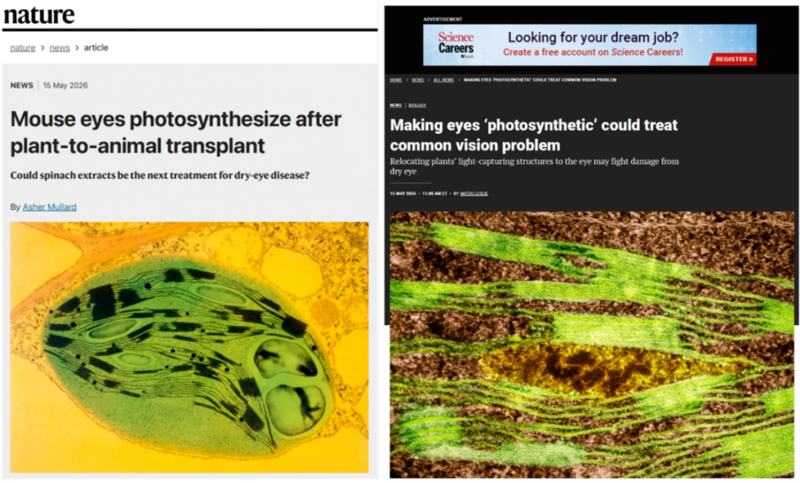
Meanwhile, Science magazine reported this breakthrough study under the title Making eyes 'photosynthetic' could treat common vision problem, and Nature covered it with Mouse eyes photosynthesize after plant-to-animal transplant.
This work was supported by the Jiangsu Provincial Basic Research Program. Professor Ding Xianguang was responsible for experimental design and data analysis, and provided ongoing guidance in refining the core concepts of the study as well as in the writing and revision of the manuscript.
(Author: Ding Xianguang, Mao Xianfeng; Initial Review: Luo Zhimin, Cai Zhikuang; Editor: Wang Cunhong; Final Review: Zhang Feng)