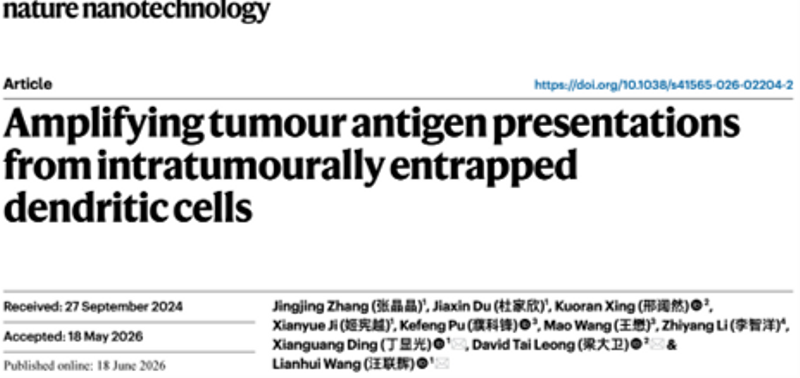
Recently, the research team led by Prof. Wang Lianhui and Prof. Ding Xianguang from the State Key Laboratory of Flexible Electronics, the School of Chemistry and Life Sciences, and the National Key Laboratory of Intelligent Bio-Materials and Diagnostic Therapeutics (Cultivation Base) at NJUPT, in collaboration with Prof. Liang Dawei from the National University of Singapore, published a research paper titled Amplifying tumour antigen presentations from intratumourally entrapped dendritic cells in the journal Nature Nanotechnology. The study proposes a novel in-situ tumor immune ignition technology based on ginseng-derived nanoparticles.
Radiotherapy, chemotherapy, and local ablation are important clinical approaches for treating solid tumors. These modalities destroy tumor cells, control local lesions, and promote the in-situ release of tumor antigens. However, tumor destruction does not necessarily equate to sufficient activation of the immune system. The key challenge in solid tumor immunotherapy is how to make the tumor antigens released by local therapies visible to the immune system.
Building on their previous series of studies on the molecular information analysis, interfacial regulation, and immunological applications of biological vesicles (Nat. Nanotechnol. 20, 156 (2025); Nat. Commun. 15, 3343 (2024); Nat. Commun. 16, 2924 (2025); Nat. Commun. 17, 4490 (2026)), the team extracted natural vesicle-like nanoparticles from ginseng and functionalized their surface with the biomedical material hydroxyapatite. This led to the development of an immune ignition nanotechnology, transforming ginseng-derived nanoparticle, whoich are rich in immunomodulatory active components, into igniters that amplify in-situ tumor immune signals.
The advantage of this technology is not merely its natural origin compared to plain ginseng, but rather its ability to convert the immunomodulatory activity of ginseng into a nanoscale immune platform that can be selectively taken up by target cells, locally delivered, and engineered for regulation. After entering the body, plain ginseng or its extracts are subject to absorption, metabolism, and tissue distribution, making it difficult to precisely target intratumoral immune cells. In contrast, the immune ignition technology, based on ginseng-derived nanoparticles and functionalized with hydroxyapatite, enables the release of calcium ions in the acidic environment within targeted cells. This activates signaling pathways related to extracellular vesicle biogenesis, prompting dendritic cells (DCs), the sentinels and instructors of the immune system, to massively secrete their own extracellular vesicles. These vesicles carry tumor antigen information from the local tumor site to lymph nodes and further activate T cells, thereby amplifying the local therapy-induced antitumor immune response. In multiple solid tumor models, the combination of local therapies (represented by radiotherapy) with immune ignition technology demonstrated superior antitumor efficacy compared to monotherapy. Notably, in bilateral tumor models, local therapy not only inhibited the primary tumor but also suppressed the growth of distal untreated tumors, while enhancing immune memory and protection against lung metastasis. This suggests that the strategy can convert localized tumor destruction signals into a broader systemic antitumor immune response.
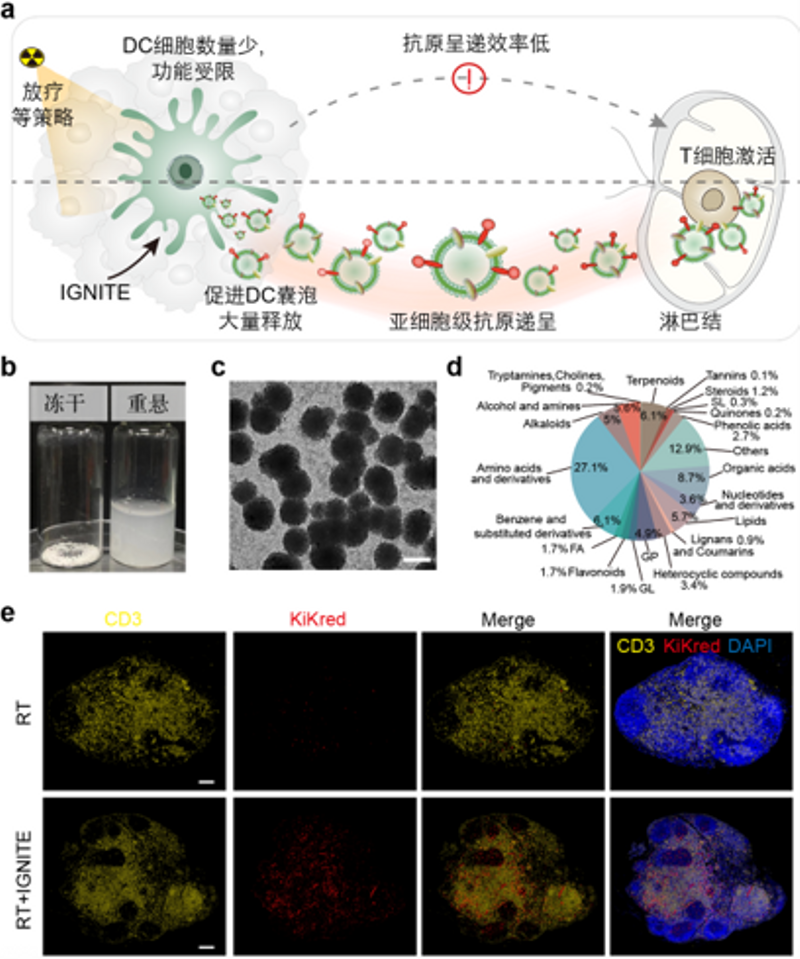
From a clinical translation perspective, this immune ignition technology offers a novel approach distinct from traditional tumor vaccines or dendritic cell therapies. It does not rely on the pre-selection of single antigens, nor does it require the in-vitro preparation and reinfusion of large numbers of immune cells. Instead, it utilizes the complex antigen spectrum released in-situ by local tumor treatment to activate dendritic cells already present within the tumor, amplifying their capacity to transmit immune information. Looking ahead, this strategy, moving from ginseng supplementation to immune ignition, could be further explored for oral delivery and combined with clinical treatment scenarios such as radiotherapy, chemotherapy, immune checkpoint inhibitors, or ablation to enhance in-situ tumor immune activation.
PhD candidate Zhang Jingjing from NJUPT is the first author of the paper. The corresponding authors are Prof. Ding Xianguang, Prof. Liang Dawei, and Prof. Wang Lianhui.
(Author: Ding Xianguang; Initial Review: Luo Zhimin, Qiao Zuqin, Dai Xiubin; Editor: Wang Cunhong; Final Review: Zhang Feng)