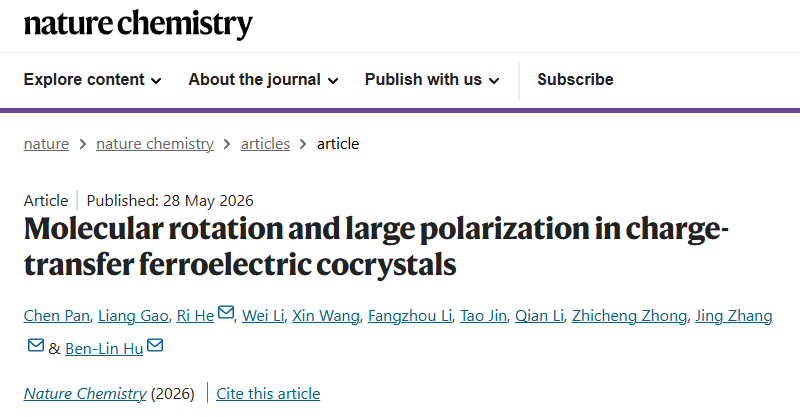
Recently, the research team led by Prof. Zhang Jing from the State Key Laboratory of Flexible Electronics and the School of Materials Science and Engineering at NJUPT, in collaboration with the team led by Researcher Hu Benlin from the Ningbo Institute of Materials Technology and Engineering, Chinese Academy of Sciences, has made significant progress in the field of flexible molecular ferroelectrics. The team developed a novel organic donor–acceptor cocrystal that exhibits large polarization intensity, low coercive electric field, and excellent stability at elevated temperatures. On May 28, the related research findings were published in the international academic journal Nature Chemistry under the title Molecular rotation and large polarization in charge-transfer ferroelectric cocrystals. Master's student Pan Chen and PhD student Gao Liang are the co-first authors of the paper, with Prof. Zhang Jing, Researcher Hu Benlin, and Researcher He Ri serving as the co-corresponding authors.
Compared with traditional inorganic ferroelectric materials, organic ferroelectrics offer significant advantages including flexibility, lightweight nature, ease of processing, and excellent biocompatibility, making them ideal candidates for emerging wearable electronics, flexible electronic devices, and biomedical equipment. However, despite their promising application prospects, organic ferroelectrics still suffer from notable performance shortcomings: generally low polarization intensity and low Curie temperature (TC), which limit their application scope and compromise device performance. To address these challenges, the team developed a polar donor–acceptor cocrystal DNF–DTTCNQ constructed through crystal structure design and supramolecular optimization. In this system, V-shaped π-conjugated donor molecules adopt a dimeric gear-like tilted packing mode within the cocrystal framework, demonstrating ultra-high theoretically predicted polarization intensity. Second-harmonic generation (SHG) measurements further confirmed the symmetry breaking in DNF–DTTCNQ. In addition, local piezoresponse force microscopy (PFM) switching experiments on DNF–DTTCNQ revealed characteristic ferroelectric hysteresis loops and butterfly-shaped amplitude curves. The coercive field (Ec) derived from the P–E hysteresis loop along the c-axis is approximately 0.44 MV/m, with a maximum polarization (Pmax) of about 70 μC/cm² and a remanent polarization (Pr) of about 58 μC/cm². These properties outperform previously reported organic ferroelectrics, and this molecular design strategy provides a new pathway for designing high-performance organic ferroelectrics.
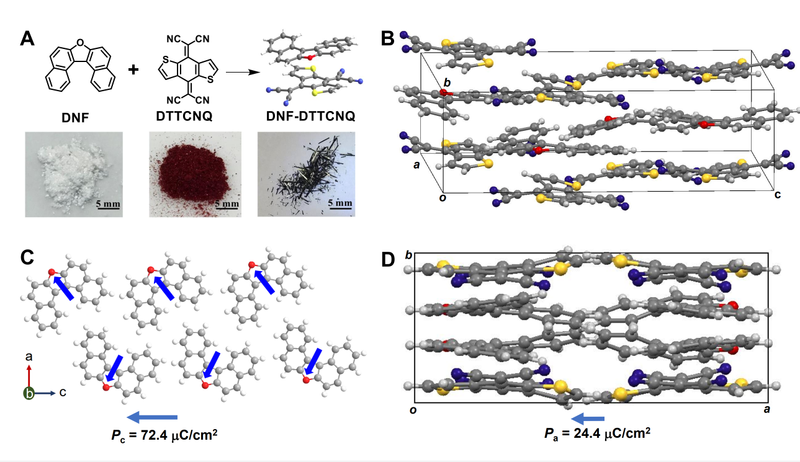
Crystal structure and predicted polarization intensity of DNF–DTTCNQ
As the temperature rises to 443 K, characteristic P–E hysteresis loops can still be observed, with Pr remaining as high as 45 μC/cm², indicating that DNF–DTTCNQ not only possesses high polarization intensity but also exhibits excellent thermal stability. Unlike conventional out-of-plane polarization switching mechanisms, this cocrystal exhibits a chain-like in-plane gear-like rotation under an electric field, requiring only 42° to achieve complete polarization reversal. This novel mechanism brings a low coercive field, enabling devices to achieve low power consumption, high durability, high reliability, and excellent dynamic performance.
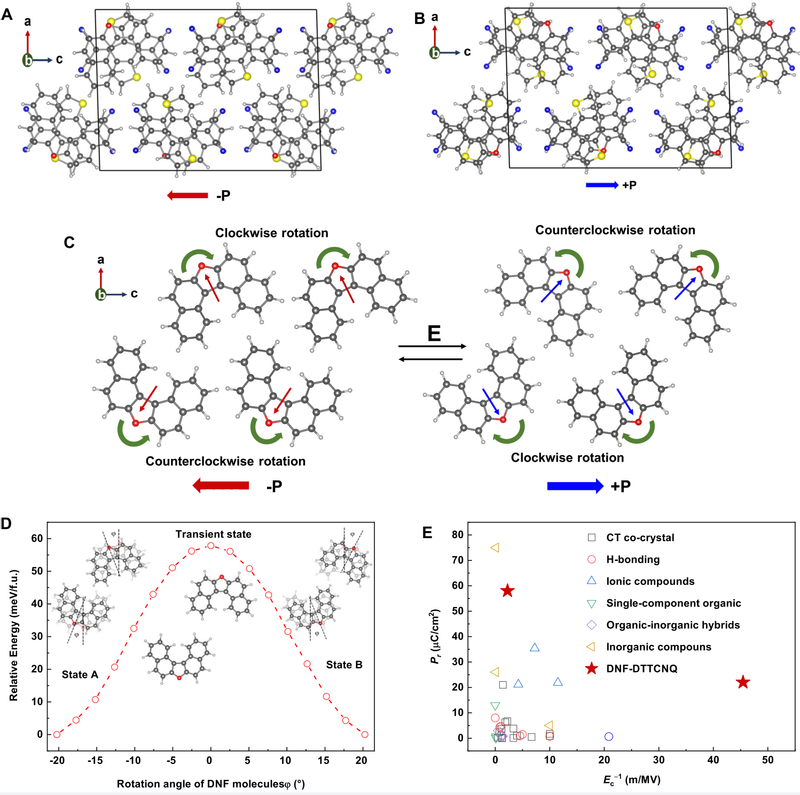
Ferroelectric polarization switching mechanism of DNF–DTTCNQ
This work was supported by several programs, including the National Key R&D Program of China, the Jiangsu Provincial Basic Research Program, the National Natural Science Foundation of China, the Zhejiang Provincial Natural Science Foundation, and the AI + New Materials Basic Research Talent Highland Project.
(Author: Zhang Jing; Initial Review: Gao Zhihua, Dai Xiubin; Editor: Wang Cunhong; Final Review: Zhang Feng)