A research team led by Academician Huang Wei and Prof. Xin Ying from the State Key Laboratory of Flexible Electronics and the School of Chemistry and Life Sciences at NJUPT has achieved a breakthrough in the field of Cu-Zn-Sn-S-Se thin-film solar cells. On September 15 (Beijing time), the related result, titled “Solution-processed kesterite solar module with 10.1% certified efficiency” was published in the international academic journal Nature Energy (DOI: 10.1038/s41560-025-01860-3). NJUPT is the sole corresponding institution. Academician Huang Wei, Prof. Xin Ying, and young teacher Wang Shaorong serve as co-corresponding authors, with PhD student Xiang Chunxu and master’s student Yuan Mingjun as co-first authors.
The team obtained large-area uniform CZTSSe thin films and record-efficiency solar cell modules via a solution process. They identified the factors limiting the uniformity of CZTSSe films, and improved film uniformity and module efficiency by regulating solution composition to increase film porosity, which promotes uniform vertical crystallization and lateral grain growth. By optimizing the module structure to reduce current loss and resistance consumption caused by non-ideal contacts and patterning, the team further enhanced module efficiency. The resulting module, with an area of 10.48 cm², achieved a certified efficiency of 10.1% from the U.S. National Renewable Energy Laboratory (NREL)—setting a world record for CZTSSe module efficiency.
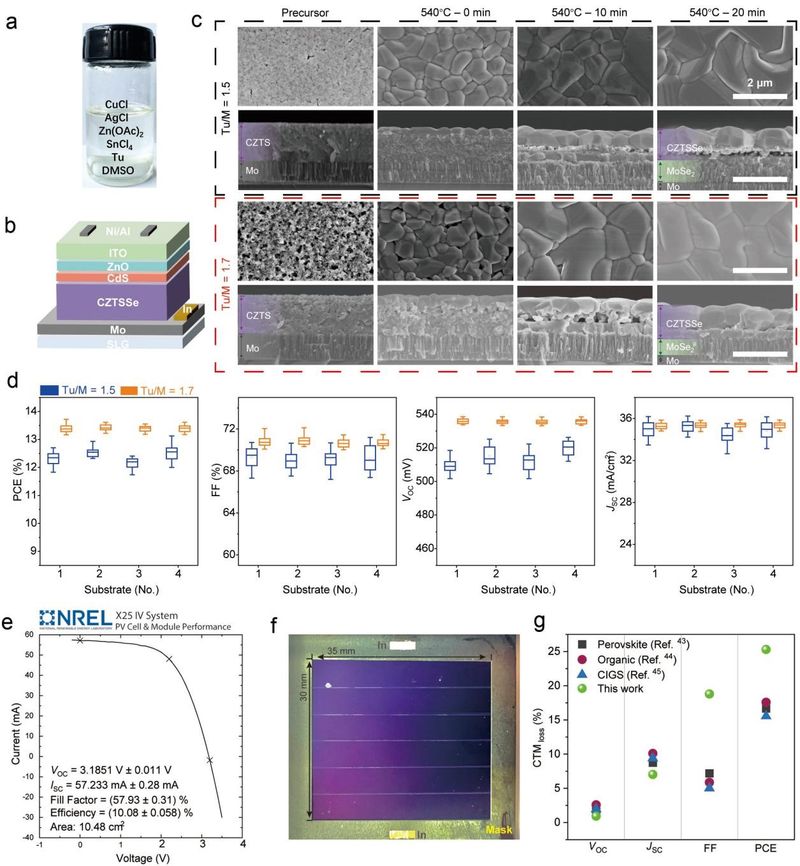
(a)Precursor solution photograph; (b) Schematic diagram of CZTSSe solar cell structure; (c) Surface and cross-sectional SEM images of precursor films and absorber films (prepared from solutions with different compositions: Tu1.5, Tu1.7) at different selenization stages; (d) Photovoltaic parameter statistics of Tu1.5 and Tu1.7 solar cells; (e) I-V curve of the NREL-certified 10.08% efficiency CZTSSe module; (f) Front photograph of the certified module; (g) CTM (Cell to Module) loss comparison of thin-film solar cell modules (perovskite, organic, CIGS, CZTSSe).
Large-area, low-cost solution-processed thin-film solar cells have become a frontier of next-generation photovoltaics, with rapid development in perovskite and organic solar cell fields. CZTSSe, a multi-component inorganic compound with a kesterite structure, has abundant constituent elements, high absorption coefficient, high theoretical conversion efficiency, and good stability, making it another emerging thin-film solar cell that can be prepared via solution. However, unlike organic or perovskite films which can directly form the target structure during solvent evaporation or in solution, CZTSSe thin-film solution preparation involves two key steps: precursor film deposition and high-temperature selenization crystallization. This process entails intricate phase evolution and grain growth, posing significant challenges for producing large-area uniform films and high-efficiency modules suitable for practical applications.
To address this issue, the team first explored the root cause of poor CZTSSe film uniformity. They discovered that an overly dense crystalline layer forms on the film surface in the early selenization stage, severely blocking selenium vapor penetration into the film interior, leading to uneven grain composition and crystallinity in vertical and lateral directions. By adjusting the thiourea-to-metal ratio (Tu/M) in the solution from 1.5 to 1.7, the team effectively increased precursor film porosity. The looser structure not only allowed sufficient selenium penetration into the film during selenization but also provided space for lateral grain growth, significantly improving film uniformity and surface flatness. The average efficiency of single-junction cells increased from 12.4% to 13.4%, with the standard deviation decreased from 0.29% to 0.13%. The large-area CZTSSe film prepared under these conditions maintained excellent uniformity, yielding a module efficiency of 8.91%. Further optimization of the module structure shortened the current transmission path along the low-conductivity ITO channel and high-resistance MoSe₂ layer, improving the fill factor and module efficiency to a certified 10.1% (10.48 cm² effective area). The open-circuit voltage and current density CTM losses of this module are lower than those of perovskite, organic, and CIGS thin-film batteries.
This work not only achieves a major breakthrough in CZTSSe modules but also demonstrates the feasibility of solution-based large-area uniform multi-component inorganic compound film preparation. It provides a clear and feasible technical pathway for solution processing of high-performance multi-component inorganic compound thin-film solar cells and modules, offering a practical scheme for the industrialization of green, low-cost photovoltaic technology.
This research was supported by programs including the National Key R&D Program, the Shandong Provincial Natural Science Foundation Major Basic Research Program, the National Natural Science Foundation of China, and the Jiangsu Provincial Graduate Research and Practice Innovation Program.
(Author: Xin Ying, Wang Shaorong; Initial Review: Qiao Zuqin, Dai Xiucheng; Editor: Wang Cunhong; Final Review: Zhang Feng)