
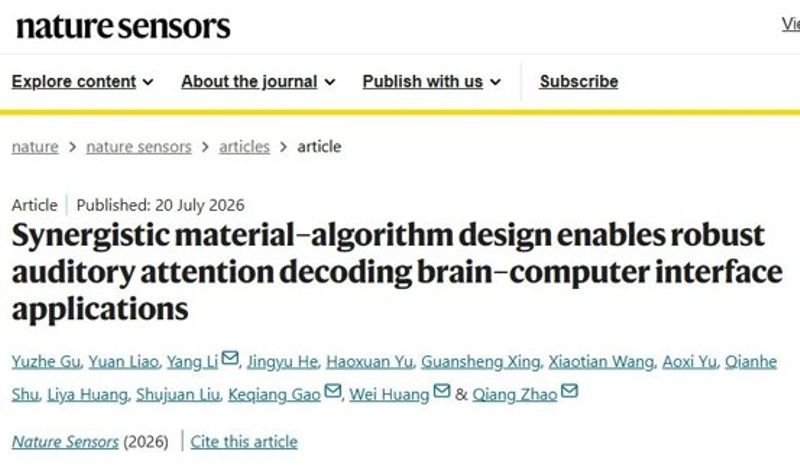
Recently, the research team led by Professors Qiang Zhao, Yang Li and Academician Wei Huang from the National Key Laboratory of Flexible Electronics at Nanjing University of Posts and Telecommunications (NUPT) has achieved significant progress in brain‑computer interface (BCI). The related findings were published in the top international academic journal Nature Sensors under the title “Synergistic material-algorithm design enables robust auditory attention decoding brain-computer interface applications”. Professors Yang Li, Qiang Zhao and Academician Wei Huang of NUPT, together with Associate Professor Keqiang Gao from Nanjing Medical University, serve as co-corresponding authors of the paper. Yuzhe Gu, a PhD candidate from the School of Materials Science and Engineering at NUPT, is a co-first author.
Humans can voluntarily filter target voices amid noisy environments, yet people with hearing loss often struggle to identify target speakers. Electroencephalography (EEG)-based BCIs capture neural responses evoked by auditory tasks and infer attention states through brainwave analysis, thereby revolutionizing hearing-assistive technologies. Nevertheless, existing BCI systems require full-scalp wet electrodes and sophisticated decoding algorithms to extract attention cues. These systems suffer from cumbersome operation, poor wear comfort, gel degradation and unsatisfactory biocompatibility. To address these limitations, the team led by Professors Yang Li and Qiang Zhao proposed a synergistic framework integrating low-impedance flexible electrode materials and lightweight neural decoding algorithms, offering an effective solution for developing practical low-power wearable BCIs.
The team developed a simple and efficient synthesis route for 3,4‑ethylenedioxythiophene (EDOT) oligomers. Using organic solvents as the medium, EDOT polymerization proceeds at room temperature under acidic conditions without extra oxidants, enabling the fabrication of zwitterionic hydrogel electrodes. The oligomers exhibit excellent solubility and can form continuous conductive networks within the hydrogel. The resulting electrodes feature substantially lower interfacial impedance than those made from commercial PEDOT:PSS and electrodes prepared via conventional oxidative polymerization. The zwitterionic matrix also endows the electrodes with outstanding mechanical properties, long-term adhesion and biocompatibility. Implanted into rat cortexes, the devices can stably acquire EEG signals and control a robotic arm based on steady-state visual evoked potentials (SSVEPs), achieving recognition accuracy exceeding 98%.
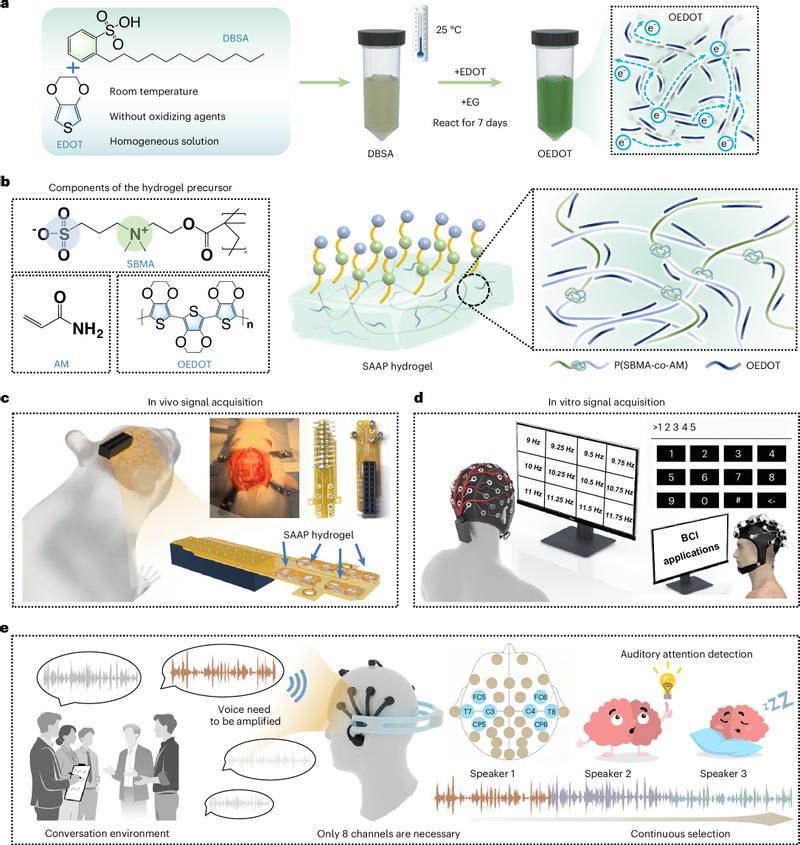
Preparation of Oligomer‑based Conductive Hydrogel and Its Brain‑Computer Interface Applications
Beyond material development, targeting sparse-channel auditory attention decoding, the team designed SDBforme, a lightweight low-power spiking Transformer architecture. DE-SDBformer with differential entropy features has only 0.13M parameters and consumes 0.0206 mJ per inference. Combined with the hydrogel electrodes, the system reaches a decoding accuracy of 90.7% using merely 8-channel temporal EEG signals, with performance comparable to conventional wet electrodes. This work integrates conductive polymer materials, flexible electrodes and lightweight decoding algorithms, providing a reliable technical approach for neuroengineering scenarios such as auditory monitoring and intelligent hearing aids.
The team has long devoted efforts to flexible sensing and brain-computer interfaces, establishing a complete integrated research system covering functional materials, flexible devices and intelligent algorithms. In the field of flexible electrodes for electrophysiological signal recording, the group has developed low-impedance long-lasting flexible EEG electrodes to tackle drawbacks of traditional wet electrodes including insufficient stability and poor skin conformity. To overcome challenges associated with weak EEG signals and difficult signal amplification, stretchable organic electrochemical transistor sensing units have been further developed to realize low-noise acquisition and amplification of faint brain signals. In addition, the team constructed lightweight BCI decoding frameworks and validated multiple BCI applications to promote practical deployment, achieving full-chain technological innovation.
This research was supported by the Excellent Group Program (Type A) of the National Natural Science Foundation of China, the National Natural Science Foundation of China for Young Scientists, the Key Basic Research Program of Jiangsu Province, and the National Key Laboratory of Flexible Electronics.
(Author: Yang Li Preliminary Review: Yannan Xie, Zhihua Gao, Xiubin Dai Editor: Cunhong Wang Final Review: Feng Zhang)